WELCOME TO ELAND BOOKS
follow on INSTAGRAM
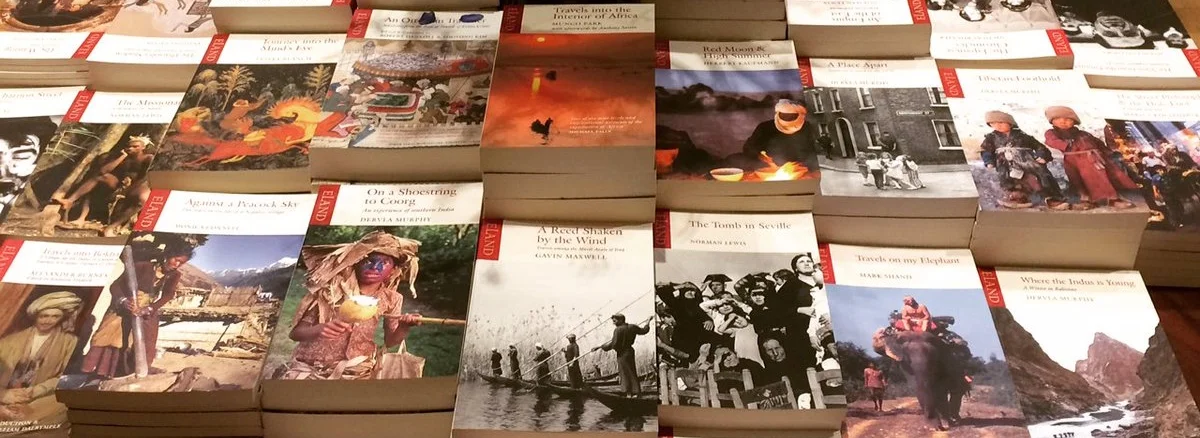
Eland houses an unrivalled collection of books about the world and its societies. The titles explore the magic of our cultures, their humour, their common humanity and their inspiring differences. For the price of a good bottle of wine our travel books offer inspiration for passionate exploration – in the company of authors who really know, and who know how to tell it. Eland (1982-2022): Celebrating our differences for 40 years
We have an annual subscription service, where for an annual fee we send you all our books, as they come hot from the printing press – for full details go to our books page
Our most recent titles: A Quiet Evening: The Travels of Norman Lewis, edited by John Hatt and Welcome to Paradise by Mahi Binebine.
LISTEN WITH ELAND
Dervla Murphy: 1931–2022
Dervla is celebrated on both BBC Radio 4’s Great Lives series and on the Slightly Foxed podcast, links below
BBC Radio 4, Great Lives: Dervla Murphy. Chosen by Hilary Bradt, founder of Bradt Guides, with presenter Matthew Parris and editor Rose Baring. To listen click here
The Slightly Foxed Podcast: Dervla Murphy, A Life at Full Tilt. With presenter Rosie Goldsmith and guests, Ethel Crowley, Rose Baring, Gail Pirkis and Steph Allen. To listen click here
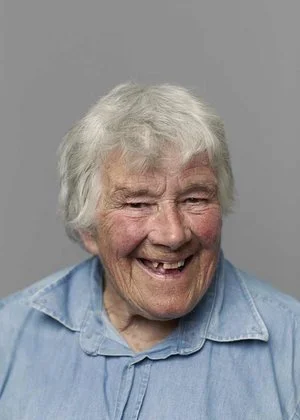
Celebrating and remembering the life-force that was Dervla Murphy, who died at home at the age of 90. Thank you for your friendship, your principled wisdom, your questing conversation and your unflinching books. 22nd May 2022 To hear tributes to Dervla Murphy, winner of the Edward Stanford Outstanding Contribution to Travel Writing Award 2021, from Michael Palin, Colin Thubron, Hilary Bradt, Lois Pryce and the Eland team click here Read Ethel Crowley in The Irish Times on the anniversary of Dervla’s death here
Travel Writing World is an award-winning podcast with wide-ranging interviews with Jeremy Bassetti featuring a number of Eland authors, to listen to his conversations click here
Al Hakawati (the Storyteller) The HandsUp Foundation is a charity raising funds & awareness for aid to Syria. Anthony Sattin joins Petroc Trelawny and Brigid Keenan in reading from an Eland classic. To listen click here
The Slightly Foxed podcast Listen to our publisher Barnaby Rogerson on the art of travel writing here and Justin Marozzi on his bookshelf in Tripoli and Gerald Hanley’s Warriors here
To listen to Barnaby Rogerson talking about the Eland list listen here to Anthropology-lite on Ryan Murdock’s Personal Landscape’s podcast
Upcycling Travel Writing at Eland Publishing in AramcoWorld. Thank you to Matthew Teller for this superb glimpse behind the scenes at Eland Publishing in AramcoWorld’s Words from Matthew Teller, photographs from Andrew Shaylor. “Travel writing … is “a highly adaptable form” that looks outward. “Our readers relish the spirit of place and like to understand other communities.” … “The very act of remaining independent is a virtue every morning,” Rogerson says,“We don’t want to grow. We want to carry on.” To read more click here
“... a nearly extinct integrity, an eccentric passion for quality and a wonderful survivor. We are all in its debt.”
Dervla Murphy’s first book, Full Tilt: Ireland to India With a Bicycle was published in 1965 . . .
NEWSLETTERS
I first encountered Jonathan Raban as an absence, a glamorous rumour. I had come to UEA in 1970 as a graduate student. He had left the year before but was far from forgotten. The pubs where he drank were pointed out to me. One of my tutors, Malcolm Bradbury, directed me to an article he had written about the art of criticism as a form of fiction writing. The idea struck me as faintly scandalous but also very exciting. What if critics were, in their own way, story tellers? What if the purpose of criticism was to release the reader’s imagination rather than confine it in concepts? There seemed to be something free spirited about his writing. He didn’t want to get boxed in by oppositions between the modern and the traditional, or the English and the American, but would think on his own terms about what he liked and what he didn’t. I wanted to read more.
https://mailchi.mp/96d51859b721/eland-newsletter-remembering-jonathan-raban?e=c80ff7272f
First person that inspired you to become a story-teller? Be it teacher, grandmother, the radio.
The first story-teller I knew was my grandfather, the broadcaster and author SPB Mais, and he was the reason why I never wanted to become a writer myself. Quite famous in his day, now forgotten, he wrote upwards of 300 books (with titles like Some Books I Like, and its sequel More Books I Like). When he died, bankrupt and heartbroken after his wife of 60 years ran off with someone else, I thought, If that’s what it means to be a writer, count me out.
Thankfully, the second writer I met was Jorge Luis Borges. As a teenager in Buenos Aires, I’d climb to his apartment in Avenida Maipu and read Kipling and Hamlet to him (after first asking if Borges would contribute a poem to my school magazine). He was the reason why I wanted to become a writer. One of his beliefs was that every writer invents their own precursors.
Read more
When Peter Mayne visited the shrine of Ghazi Baba, it was being rebuilt, “so that what was once a modest little place perched on a rock is now going to look like a provincial movie-house”. The functional stairs that lead up to the shrine retain a quasi-commercial feel seventy years on. There is no doubting the fervour of those ascending them though, and that, together with the humour and humanity that he encountered in rural Sindh, seem little changed.
Cities are different and there is a familiar sense of purpose in Karachi. Pedestrians, fixed on personal ends, eschew eye contact with passers-by. Like New York, Hong Kong or Mumbai, other port cities grown great from immigration in recent centuries, Karachi’s monuments consciously proclaim the wealth that was generated here. The extensive yellow sweep of the domed Karachi Port Trust is a temple to commerce, while the Gothic Revival Frere Hall, once the town hall, blends Italianate and Moghul influences, with a slender spire on top that wouldn’t look out of place on a Zurich church.
Read more
First person that inspired you to become a story-teller? Be it teacher, grandmother, the radio.
Working-class kids didn’t have books in the early sixties and nobody told stories, except about the football. When I was about nineteen, Arthur Grimble’s A Pattern of Islands made me realise what travel writing could do – that it was the perfect vehicle in which to smuggle in the ineffable.
Is there a home? How many? Where do you write now?
Yes there is a Victorian butcher’s shop on Hampstead Heath that has been home for thirty years. I write wherever I am – it’s a wholly inaccessible luxury not to have to get on with it every single day. What would one tell the gas man?
Writer or travel-writer or adventurer ? How will booksellers describe you, when we want to carry on selling your books?
‘Writer’ is quite enough
Read more
If you have not yet read Brazilian Adventure or News from Tartary you are in for a roller-coaster of adventure and misadventure. You will also be left in awe at the stamina, bravery, enterprise and self-deprecating humour of Peter Fleming, as well as appreciating the nonchantly camouflaged steel of his ambition. He is a fascinating example of pluck in whatever extreme situation he finds himself, but always given an individual twist, for his adventurous spirit was married to a rapier-like skill with words and a dedication to the truth. He also had a lifelong delight in the theatre, which he put into practice by marrying one of the great actresses of the age, against the determined opposition of his mother. His friends recognized this rare combination of physical toughness, literary precision and delight in life by likening him to a figure from Elizabethan times.
Last New Year, I ripped up a book contract. It was an intriguing sensation to free yourself from the otherwise desired embrace of a Publisher. As all hungry freelance writers know, you need to lie about your availability and accept multiple and contradictory commissions with enthusiasm. Editors do not want to employ writers who say No.
So why did I do it? Guilt about broken deadlines was not a primary concern. Deadlines are a vital aspect of newsprint journalism, but if you are writing a book they are mere fences to be jumped, as if you were an old hunter at a point-to-point. But I did know we were going forward into one hell of a year at Eland, moving all 182 titles into a new warehouse and a new distributor. I may also have talked about my next book too much, which can kill the joy of settling down in a dark corner for three months. The story had already been told. I was also enjoying the comparative success of The House Divided: Sunni, Shia and the Making of the Middle East and the invitations to book festivals.
Read more
Three Came Home, this searing chronicle of a family imprisoned on the island of Borneo in the Second World War, is the best-known of Agnes Newton Keith’s six published memoirs. It is as unlike its precursor, Land Below the Wind, as hell is unlike heaven. Entangled in hatred and cruelty, the captives’ despair was somewhat mitigated by their resourcefulness. The somewhat-mitigated despair of Three Came Home gave way in its successor, White Man Returns, to guarded hope for humankind. Keith’s three Borneo books can be viewed as chapters in the beloved American/Canadian writer’s life of travel, adventure and tribulation with her spouse. Agnes Keith’s writing is as much about Harry Keith as it is about Borneo. Harry is writ large because the writer was at first just one-half of a colourful couple. The Keiths continued to be colourful for the thirty-six-year span of Agnes’s oeuvre. But they possessed a ‘terrible knowledge’ from their wartime experience — the phrase was from Bruce Hutchison, at the time, dean of Canadian journalists: ‘She has an intimate, not to say a terrible[,] knowledge of the Japanese mind’ — and the experience gave gravitas to her writing against war.
Read More
I recently had to re-read The Innocent Anthropologist and it was a strange experience. I didn’t choose the title but I now find it wholly appropriate – none of the cringing political correctness you find in the current anthropology that has lost its cutting edge, the boundless optimism of those times, the faith in the subject itself and the value of human contact that it entails but alongside an awareness that one of the great universals is the ability to laugh at ourselves when we are at our most serious. When I showed it to my ex-tutor he warned me never to publish it as it would end any hope of an academic career. At a meeting of the Association of Social Anthropologists of the United Kingdom and the Commonwealth, a motion was proposed that I should be thrown out. It was not passed and nowadays it is often the first book prescribed on undergraduate reading lists. I feel a nostalgia for that lost me – so bright-eyed and bushy-tailed.
Read more
Gamel Woolsey, author of ‘Death’s Other Kingdom: A Spanish village on the eve
of the Civil War’. Read Michael Jacob’s afterword to this remarkable first-hand
account of the Spanish Civil War in our latest newsletter (now on our website)
alongside news from Action Syria, Cornucopia, the Dorchester Lit Fest,
Sherborne and Ilse Schwepcke
‘Of all the foreign eyewitness accounts of the Spanish Civil War, Gamel Woolsey’s
Death’s Other Kingdom is one of the most moving and unusual. It is one of the few
records of the war that is fuelled more by a love of Spain and its people than by
any firm ideological standpoint. Woolsey was someone whose political position
ran contrary to the Left Review’s famous assertion of 1937 that it was impossible
for authors not to take sides on the issue of being for or against Franco and
Fascism. But then, to her contemporaries, she would barely have been
considered an author at all. By the time of her death in 1968, she seemed
destined to go down in history merely as the wife of the writer and Hispanist
Gerald Brenan … Rereading the book today, one is struck by how pertinent it
remains as a commentary on war in general, and on war’s impact on the lives of
those ordinary human beings whom the rhetoric of politics and ideology never
reaches.’ Michael Jacobs
Read More
It was our first morning in Iran.
Mashhad was our base for the first couple of days, as we acclimatised and explored the north-east of the country. The distances were vast, and some of the journeys were clearly experimental, but to be seeing things in Iran that Bruce had never seen was a privilege in itself. Our second day took us towards the Afghan border but was broken by a two-mile walk so that we could arrive at an isolated Seljuk caravanserai having understood something of the landscape. Our trip to discover the secret encampment of Nadir Shah (where his treasure had been stored and where he was murdered by his own bodyguard) was accompanied by a thunderstorm that swept a river of mud, speckled with vast boulders, across the road. Like all Bruce missions there was an inscription to be identified – up a narrow mountain gorge, carved into the living rock – which took us through a nomad encampment where he picked up a charming young guide. He was delighted to find that the inscription, like Nadir Shah himself, was vast and imposing, but essentially Turkic with Persian embellishments.
Read more

Norman Lewis wrote thirteen novels and thirteen works of non-fiction, mostly travel books . . .